
Most AI writing tools produce a chapter, then forget who the murderer was. CaseBound, launched on WarriorPlus on 20 October 2026, tries to fix that by building the solution first. You develop the culprit, motive, timeline, suspects and clues, run a twelve-check audit, and only then outline and draft the chapters, all through your own Claude account. It comes in three editions at $27, $97 and $147, with a $9.97 bump and four upgrades behind them. This CaseBound Review covers what the studio does, how its proof holds up, what the funnel really costs, and what could not be verified.
Ready to Explore CaseBound?
Discover how CaseBound’s case-first AI mystery-writing workflow helps organize suspects, clues, motives, and chapter outlines before drafting your novel. Read the full review to understand its features, pricing, Claude requirements, and licensing limits.
Get access to a bonus package worth $1,000+ when you use our link, subject to the offer’s terms.
Review the complete pricing and licence terms before purchasing. Bonus availability and conditions may apply.
Table of Contents
What Is CaseBound? A Closer Look at the Book Creation Tool
In this CaseBound Review, we examine a browser-based AI mystery-writing studio created by Kevin Berry. Designed for mystery authors and aspiring fiction writers, CaseBound aims to simplify the process of planning, structuring, and drafting mystery novels with the help of Claude AI.
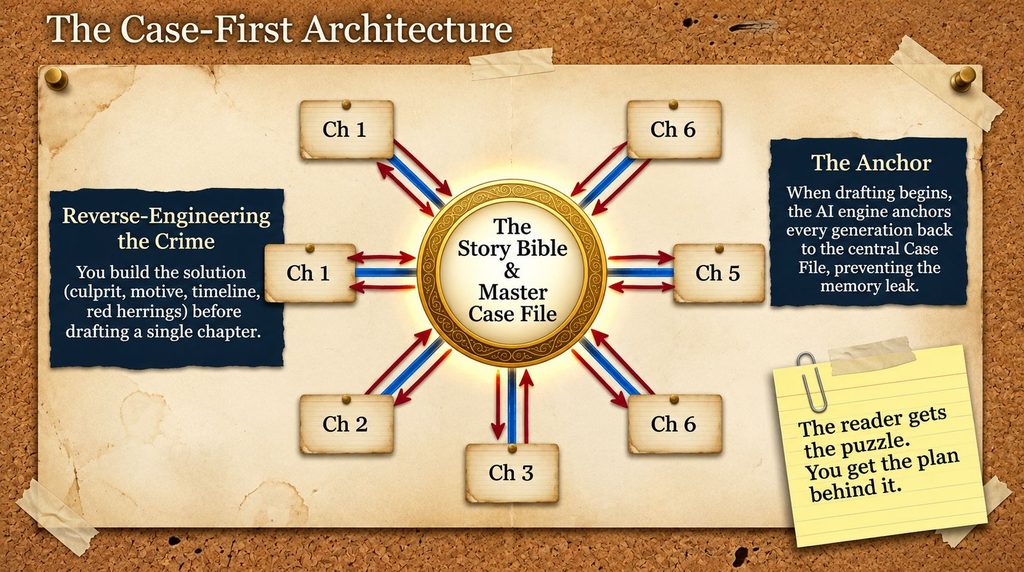
CaseBound is not a general-purpose AI writing tool. CaseBound follows a case- approach. CaseBound helps you set up the mystery’s hidden truth before you write the story that shows it. This means you make the culprit, motive, timeline, suspects, clues and red herrings first. After that you write the manuscript.
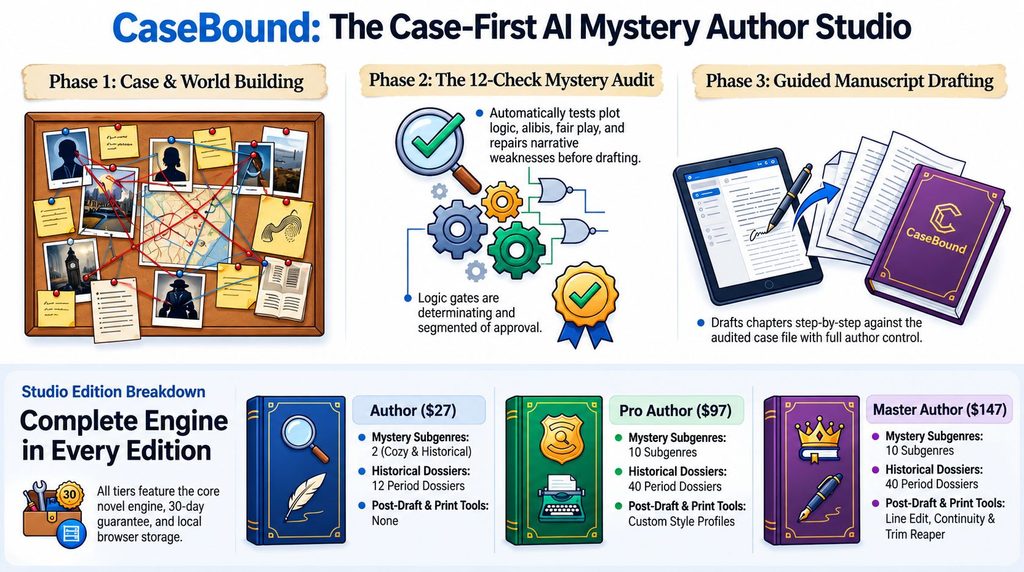
The CaseBound writing process has three phases. First you pick a mystery subgenre and premise. Give your own idea. Next the studio builds the case file. Runs a 12-check Mystery Audit. In this stage CaseBound also makes a story bible and a chapter outline to keep the book consistent.
In the phase CaseBound uses the case file, story bible and outline to steer chapter drafting. You can edit the text at every step save your progress and ask for revisions as your story grows.
One of the features that the vendor points out in this CaseBound Review is the Mystery Audit. According to the vendor this audit checks things like motive, alibis, timing fair-play clues. Whether the solution becomes obvious too early. The audit also requires least three believable suspects and suggests fixes when it sees weaknesses. Still the vendor says writers must read and polish the results themselves.
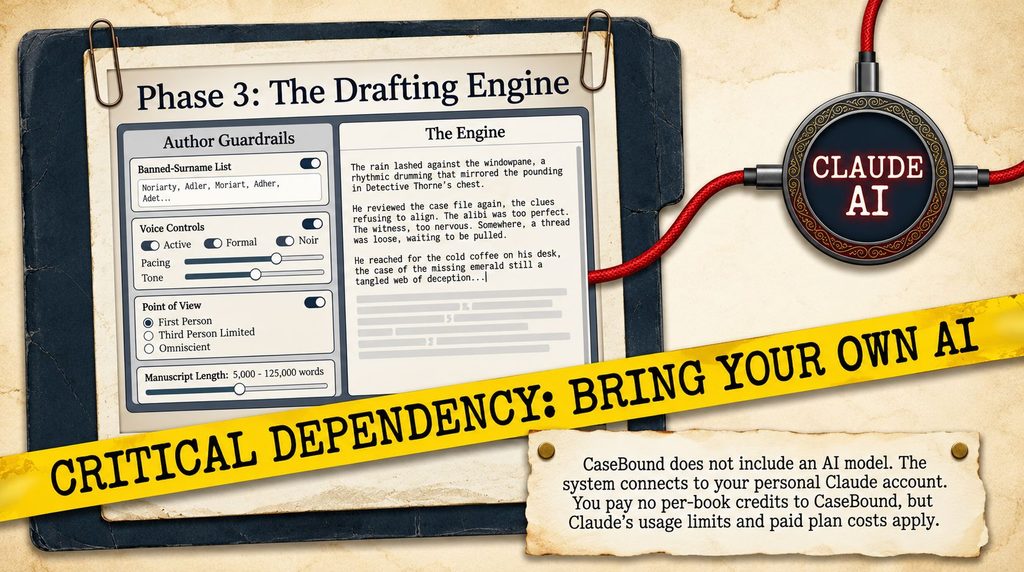
Other claimed features of CaseBound include dozens of blueprints support for 13 writing languages, manuscript lengths from 5,000 to 125,000 words, a banned-name list to avoid common AI-generated character names and a character name generator. The studio also lists a Word-format ebook formatter, a writing sprint timer and gamified badges.
There is one requirement to know before buying CaseBound: the software uses your own Claude account. The vendor says that CaseBound does not charge credits or per-book fees but Claude’s usage limits and any subscription costs are matters.
Another important limitation is storage. Your writing projects stay in your browser not online. So you must save your work. Keep backups. If you lose browser data unsaved projects could disappear.
For transparency this CaseBound Review is based on the vendor’s published product information not on hands-on testing. The advertised features and requirements are described as they appear and claims about writing quality, mystery consistency and overall performance should be treated as unverified until tested by others.
Overall CaseBound presents itself as an AI mystery-writing solution for authors who want to organize the plot before drafting chapters. Whether it is worth the investment depends on how its workflow fits your writing process your access, to Claude and your willingness to review and back up your work.
Who Created CaseBound? Vendor Background and Product Details
An important part of this CaseBound Review is knowing who made the software. Kevin Berry must have a proven publishing record. The CaseBound sales page is signed by Kevin Berry and the Terms and Refund Policy also identify Kevin Berry as the seller. Kevin Berry is a New Zealand author with a documented publishing history.
The Science Fiction Encyclopedia lists books published by Bluewood Publishing co‑written with Diane Berry under the name K D Berry and also lists The Fairytale Factory. Sir Julius Vogel Award records show Kevin Berry as a 2017 finalist for a youth novel and the 2018 winner in the cover category for Kevin Berrys book Teleport. A biography on a website also mentions two Awesome Indies seals.
These records broadly support the credentials presented on the CaseBound JV page. However the claims of 3,800 books sold 1.2 million Kindle pages. Five‑figure royalties come from Kevin Berry and could not be independently verified.
Overall Kevin Berry has a documented author background and is clearly identified as the seller providing useful transparency when evaluating CaseBound. However Kevin Berrys publishing credentials alone do not prove the softwares performance. Guarantee results, for buyers.
CaseBound Editions Compared: Features, Differences, and Best Fit
Every edition includes the complete engine. The differences are in reach and tools.
Author, $27. Classic Cozy and Historical Mystery subgenres, 12 researched historical period dossiers of about 20,000 words each, the full audit, blueprints, formatter, name tools and the extras above.
Pro Author, $97 (marked “Recommended”). Everything in Author, plus eight more subgenres (including paranormal cozy, police procedural, private investigator, crime noir, Scandinavian noir, legal and medical), 28 more dossiers for 40 in total, The Morgue, which researches a custom time and place, a writing style profile built from your own document or description, and 53 mystery-specific writing styles.
Master Author, $147. Everything in Pro, plus Fieldwork Line Edit (removes common AI tells and applies 40 line-editing rules), Fieldwork Continuity (checks events against your timeline and proposes fixes), Trim Reaper (formats a paperback interior with the right gutter, five free fonts) and Reader Reach promotion plans.
Two launch bonuses are included: a market analysis of 1920s Scottish cozy mysteries ($37 value) and a 25,000-word 1924 Edinburgh period dossier ($27 value). The values are the vendor’s own, and the bonuses are tied to the launch.
You can upgrade later by paying the difference at the prices then in force. The sales page says launch prices run from 20 to 25 October 2026 and that prices rise afterwards, without saying by how much.
CaseBound Review Proof: Examining the Six Published Books
The convincing proof shared in this CaseBound Review is the vendors report of six books made using the software: one Victorian mystery and five cozy mysteries. For A Murder in Tanners Lane, which came out on 23 September 2026 the page shows 42 units sold 4,168 Kindle pages read and $135.88 in estimated royalties. In total for all six books the report says 148 units sold 8,840 pages read and $308.10 in estimated royalties.
The vendor says these numbers are estimates, not sure results or confirmed money in the bank. The Amazon page for A Murder in Tanners Lane is there. Looks like the sample description but it lists Suzanne Pallister as the author. The link, to Kevin Berrys claimed pen name has not been confirmed and the other five books were not looked at. In all these examples show that books can be published and sell but the money made is small and does not say what CaseBound buyers will make.
CaseBound Claude Requirement: Limitations and What You Need to Know
CaseBound does not include an AI model. You need your own Claude account, and the page says Claude’s usage limits determine how much you can do in a session. Paid plans are a separate expense, and the Terms put the account, its costs and its rules on you. The Terms also say the vendor does not promise the product will keep working with future changes to third-party services.
That matters for a long project. A novel involves many generation steps, and the page says working steadily a draft and read-through may take around two weeks, an estimate and not a promise. Claude’s plan limits and pricing were not checked here, so confirm what your plan allows before you buy.
The timing signals are mixed. A testimonial on the page says a 160-page book was finished “in a few minutes”, while the vendor’s own estimate is about two weeks. The second is more realistic.
CaseBound and Amazon KDP: Understanding AI Disclosure Requirements
The page says anything you create is yours to publish commercially, with no royalty or revenue share, and the Terms agree. It also tells you that Amazon KDP asks about AI-created content, that you should answer yes, and that you should describe your editing according to what you actually did. The Terms say you are responsible for following each platform’s disclosure rules.
That is the right advice. KDP asks publishers to disclose AI-generated content, and chapters drafted by an AI fall on the generated side. Check KDP’s current wording before you publish.
Selling a mystery is also a separate job. The page says the manuscript needs your editing, and that cover, description and promotion matter. The Master edition and the Reader Reach upgrade address some of that, and both are paid.
Is CaseBound Really $27? Why You Should Check the Full Sales Funnel
The $27 CaseBound price is a one-time payment. Does not require a studio subscription but this CaseBound Review discovered that there are extra offers hidden behind the checkout. The $9.97 Case Study bump leads to upgrades such as CaseBound Max at $67 Reader Reach at $47 or $74 when it includes PLR, the Ghostwriting Agency License at $57 and the Author Evaluation Service at $97. According to the vendors pricing examples the funnel ranges from $244 to $298.
When the bump and Reader Reach PLR are added the total climbs to $331.97 for Author buyers $334.97 for buyers and $310.97 for Master buyers. The Agency License is important because the basic license does not allow client ghostwriting. Also buying Author for $27 and adding CaseBound Max for $67 gives a total of $94, which’s $3 less, than the $97 Pro edition yet the contents listed are the same. Therefore compare the editions and licensing terms before making a purchase.
Ready to Explore CaseBound?
Discover how CaseBound’s case-first AI mystery-writing workflow helps organize suspects, clues, motives, and chapter outlines before drafting your novel. Read the full review to understand its features, pricing, Claude requirements, and licensing limits.
Get access to a bonus package worth $1,000+ when you use our link, subject to the offer’s terms.
Review the complete pricing and licence terms before purchasing. Bonus availability and conditions may apply.
CaseBound Review: Pricing, Front-End Cost, OTOs, and Total Funnel Price
Based on the live WarriorPlus affiliate dashboard and the JV page on 21 Oct 2026.
| Product | Price |
|---|---|
| CaseBound Author | $27.00 |
| Case Study | $9.97 |
| CaseBound Master Author | $147.00 |
| Case Study | $9.97 |
| CaseBound Pro Author | $97.00 |
| Case Study | $9.97 |
| CaseBound Author Evaluation Service | $97.00 |
| CaseBound Ghostwriting Agency License | $57.00 |
| CaseBound Max | $67.00 |
| CaseBound Reader Reach | $47.00 |
| The Reader Reach PLR | $27.00 |
| CaseBound Reader Reach PLR | $74.00 |
What I Liked About CaseBound: Key Features and Potential Benefits
A specific method. Building the solution before the story is a real answer to the usual AI plot problems, and the audit is a concrete check.
Visible proof. The page names a real published book you can look up, shows a sample and reports modest numbers without hype.
A credible, accountable vendor with a documented author history, named contact details and New Zealand governing law.
A clear licence statement that you own what you create, with no royalty or revenue share.
No credits or metering, and a refund policy that applies to every product.
Honest limits stated on the page: you still edit, no tool guarantees sales, KDP asks about AI use.
CaseBound Pricing Compared: Which Edition Fits Your Budget?
Just testing: Author at $27, if historical or classic cozy is what you want. The refund window runs 30 days.
Wanting other subgenres or your own voice: Pro at $97 includes eight more subgenres, 40 dossiers and style tools. Buying Max after Author costs about the same.
Planning to publish a paperback: Master at $147 adds line editing, continuity checks and Trim Reaper. Compare it with free and cheaper editing and formatting options.
Planning client work: budget for the $57 Agency License as well.
Considering the $97 Evaluation Service: wait until you have a manuscript and know what feedback you need.
Who Should Buy CaseBound? Ideal Users and Use Cases
Aspiring authors who love cozy or historical mysteries and want a structured way to plan and draft.
Self-publishers who already use Claude and want a repeatable process for several books.
Writers who dislike unplanned AI plots and want an audit before drafting.
CaseBound Value and ROI: Is It Worth the Investment?
The grounded way to weigh CaseBound is as a one-time writing tool. At $27, trying a method for historical or cozy mysteries is a small risk. At $332 for the whole path, the case rests on whether you will actually finish and edit books.
The vendor’s numbers show what a published AI-assisted catalogue can look like: six books, 148 sales and $308 in estimated royalties in a short time. That is useful as a sample and not as a forecast.
Costs beyond the price include Claude, a cover, editing, a listing and promotion. Mystery is a crowded category, and a quickly drafted book needs real editing. No income should be assumed.
CaseBound Review Verdict: Is This Book Creation Tool Worth Buying?
This CaseBound Review finds a well-structured AI mystery-writing studio created by an author with a documented background. Its case-first workflow, Mystery Audit, and published-book examples make it worth considering, although the software’s actual writing quality and audit accuracy remain untested. The sales page also omits the full upsell funnel, the base licence’s client-work restriction, and an explanation of the different author name on its sample book.
Best for: Mystery writers who want a guided plotting process, have access to Claude, and are willing to edit AI-generated drafts.
Not ideal for: Buyers expecting a finished book without effort, client ghostwriters relying on the base licence, or anyone expecting typical earnings to match the vendor’s examples.
Main reason to buy: A structured, plot-first workflow with a Mystery Audit and a low entry price.
Main reason to skip: Unverified output quality, additional funnel costs, and dependence on Claude’s usage limits.
Overall verdict: CaseBound may be a reasonable trial for the right writer, but review the licensing terms and upgrade options carefully before committing to the full funnel.
If you want to see the current offer for yourself, you can check it out here: https://warriorplus.com/o2/a/rv3pjm5/0
Ready to Explore CaseBound?
Discover how CaseBound’s case-first AI mystery-writing workflow helps organize suspects, clues, motives, and chapter outlines before drafting your novel. Read the full review to understand its features, pricing, Claude requirements, and licensing limits.
Get access to a bonus package worth $1,000+ when you use our link, subject to the offer’s terms.
Review the complete pricing and licence terms before purchasing. Bonus availability and conditions may apply.
CaseBound Review FAQ: Frequently Asked Questions Answered
What is CaseBound?
An AI mystery-writing studio by Kevin Berry that builds a case, audits it, creates a story bible and outline, and drafts chapters using your own Claude account.
How much does it cost?
$27 (Author), $97 (Pro Author) or $147 (Master Author), one-time. A $9.97 bump and four upgrades follow, and the full funnel can reach about $332.
Do I need a Claude account?
Yes. CaseBound does not include one, and Claude’s usage limits and plan costs are separate.
Can I sell the books I make?
Yes. The Terms say you own what you create, with no royalty or revenue share. You are responsible for platform rules, including KDP’s AI disclosure.
Can I write books for clients?
Not with the base licence. The Terms say agency and ghostwriting rights come only with the Agency License upgrade.
Are the six published books real?
The Victorian mystery has an Amazon listing that matches the sample, under the author name Suzanne Pallister. The pen name is not confirmed, and the other five were not checked.
Is there a refund?
Yes, 30 days by email on all products and services. A refund ends your licence.
Where is my work stored?
In your browser, not online, so back it up.
Will it make me money?
No tool can promise that. The vendor’s six books show modest estimated royalties, and he says they are not typical.