
KuroNazo is a cloud-based software designed to help users create and publish find-the-killer logic puzzle books with minimal effort. In this KuroNazo Review, you’ll learn how the platform generates puzzle books, designs matching covers, and creates Amazon-ready listings for self-publishing. We’ll also examine its key features, pricing, advantages, potential drawbacks, and whether KuroNazo is the right choice for beginners and experienced publishers looking to build a profitable puzzle book business.
KuroNazo Review —
We Found a Funnel Contradiction
Nobody Else Flagged
A same-day launch for a “find-the-killer” logic puzzle generator, from a creator team with a real back catalog. We cross-checked the funnel against outside sources, corrected an overstated rating claim floating around, and laid out exactly what’s verified versus what isn’t.
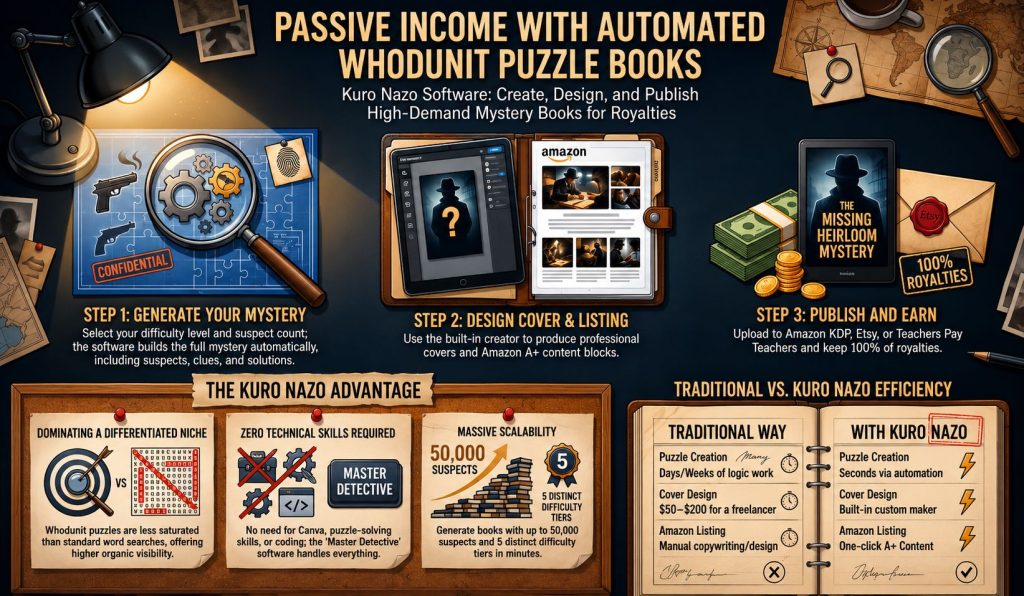
Table of Contents
What Exactly Is KuroNazo?
KuroNazo launched on July 10, 2026, so this review is written the same day — there’s no track record for the product itself yet, only for the people behind it. The pitch is narrower than most KDP puzzle software: it generates “find-the-killer” style logic puzzle books, where readers work through suspect grids, alibis, and clue chains to solve a case, rather than a standard crossword or word search. The name is a small piece of branding worth knowing — it combines the Japanese words for “dark” and “mystery,” which shows up in the tool’s visual theme and the kind of content it’s built to produce.
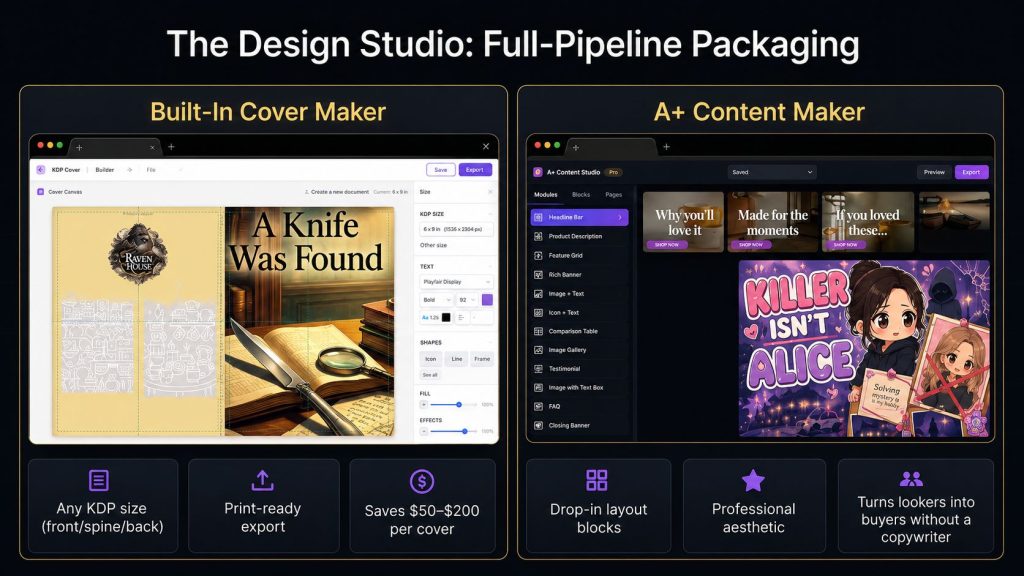
As highlighted in this KuroNazo Review, the software goes beyond a basic puzzle generator by including a cover creation tool and an Amazon listing (A+ Content) generator, positioning itself as an end-to-end solution that takes users from idea to a publish-ready listing. It runs entirely in the browser, exports both PNG and PDF files, and is offered as a one-time purchase with no recurring fee for the core license. Independent coverage also mentions support for a 10-language interface and a larger suspect pool at higher upgrade tiers, although it’s worth verifying those details against the latest sales page, as feature counts can change during a product launch.
Who’s Behind KuroNazo?
As covered in this KuroNazo Review, one of the product’s biggest strengths is the credibility of its creators. Unlike many same-day software launches, the team behind KuroNazo has an established track record. Ike Paz is a full-time digital product developer who began building online businesses in 2015. Originally from Miami and now based in Fukuoka, Japan, he ranks among the top 5% of WarriorPlus affiliates and holds Elite Vendor status. His portfolio includes well-known products such as Royalty Prints, Manaka Royalty, Sansuu Royalty, Ohanashi AI Gen, Nurie Prints, and Crispy Prints, giving KuroNazo the backing of a creator with several years of verifiable experience rather than an anonymous one-time launch.
Continuing this KuroNazo Review, it’s also worth looking at the team behind the software. Luke Bowes serves as the technical partner and leads the development side, while he and Ike Paz have collaborated on multiple software launches over the years. During our research for this KuroNazo Review, we specifically looked for recurring complaint patterns or scam allegations linked to either creator and found no direct evidence targeting this team. While broader searches do reveal general complaints about WarriorPlus as a marketplace, those concerns relate to the platform as a whole rather than KuroNazo or its creators, so it wouldn’t be accurate to attribute them to this product without supporting evidence.
Correcting the Record: What That “4.3/5 Rating” Actually Means
You may see Royalty Prints’ 4.3/5 rating described elsewhere as “independently verified” or sourced from “a third-party site outside WarriorPlus.” That framing overstates it. The 4.3/5 figure comes from WarriorPlus’s own on-platform student ratings — the same marketplace the product was sold through, not an outside review authority. A separate outside source that does cover Royalty Prints in more depth also notes that most of the positive testimonials shown on the sales page itself are pulled from Ike Paz’s YouTube comment section, with limited first-hand commentary showing up independently on platforms like Reddit or Quora.
None of this means the rating is fake or that the creator’s track record is weak — a 4.3/5 across real paying students on a marketplace is still a genuine, checkable data point, and it’s a meaningfully better
starting position than an anonymous vendor with zero history. But “on-platform student rating” and “independently verified by an outside site” are two different claims, and this review keeps that distinction
explicit rather than repeating the stronger-sounding version that doesn’t hold up on closer inspection.
The Funnel — Where Two Outside Sources Disagree
Cross-checking funnel claims against sources outside the vendor’s own JV page is something we do for every product in this project. Usually that means comparing the JV page to a live WarriorPlus affiliate dashboard screenshot. Without one for this specific launch yet, we instead compared two independent, non-JV descriptions of the funnel against each other — and they don’t agree.
One outside breakdown lists a simple four-part funnel: the front end, a Hanzai Royalty cross-sell, a Pro upgrade, and an Elite upgrade — the same structure the JV page describes. A different independent breakdown instead describes an eight-part OTO structure, including separate upgrade tiers beyond Pro and Elite, an agency/reseller edition, and a bundle or “FastPass” option covering several upgrades at once.
We’re not resolving that contradiction here, because doing so responsibly requires your live affiliate dashboard for this exact launch — not a guess at which outside source is more current. What we can say is that presenting the funnel as a “clean, fully matched” four-step structure, full stop, isn’t quite accurate to what’s publicly described about this launch. Once you share the dashboard screenshot, we’ll lock BLOCK 13’s table to whichever structure the live data confirms and note here whether the discrepancy was resolved in the vendor’s favor or not.
| Step | Product | Price | Commission | Status |
|---|---|---|---|---|
| Front End | KuroNazo | $19.00 | 50% | Confirmed on JV page |
| Cross-sell | Hanzai Royalty | $47.00 | 50% | Confirmed on JV page |
| OTO 1 | KuroNazo Pro | $57.00 | 50% | Confirmed on JV page |
| OTO 2 | KuroNazo Elite | $187.00 | 50% | Confirmed on JV page |
| Additional tiers (agency/bundle) | Unconfirmed | Unconfirmed | Unconfirmed | Reported by one outside source only |
As noted in this KuroNazo Review, one point worth clarifying—regardless of which funnel version is currently active—is that Hanzai Royalty appears to be positioned as a cross-sell rather than a direct upgrade. Based on the available information, it seems to be a separate puzzle-generation engine instead of simply an expanded version of KuroNazo. If you’re planning to purchase the Elite tier, it’s a good idea to review the Hanzai Royalty offer carefully to determine whether its features overlap with what’s already included, helping you avoid paying twice for similar functionality.
Pricing and the Refund Policy
The front end is $19 during this launch window. As with most WarriorPlus launches, expect the price to move — likely upward — as the launch period progresses, so the number you see when you click through may differ slightly from what’s captured here.
The sales page states plainly that all sales are final, since the product is a digital tool with immediate access. That’s consistent with this creator team’s policy on other recent launches — not a red flag unique to this one — but it’s still a real term, not boilerplate you can assume gets waived. If you’re not confident the tool fits your workflow, resolve that uncertainty before you buy, not after.
Software License — What “Commercial Rights” Actually Covers
KuroNazo is described as including full commercial rights on the puzzle books you create with it — meaning you own what you produce and can publish and sell it on Amazon KDP, Etsy, or similar platforms without paying royalties back to the vendor. That’s a different kind of license than PLR content rights, and the distinction matters: you’re not automatically granted rights to resell the software itself unless a specific tier says so — you’re granted rights to sell the puzzle books the software helps you generate.
As mentioned throughout this KuroNazo Review, if your goal is to resell the software under your own brand or offer client services instead of publishing puzzle books yourself, be sure to verify the licensing terms on the specific OTO page that covers agency or reseller rights. In most software funnels, these permissions are typically reserved for higher-tier upgrades rather than the front-end license. It’s also wise to review the exact license agreement and terms at the time of purchase, as they can change between launches.
About Those Testimonials — What’s Verified and What Isn’t
The sales page includes beta-tester screenshots specific to KuroNazo, plus royalty and earnings screenshots the creators are upfront about sourcing from their older software rather than this one. That second part deserves credit — a lot of launches blur that line on purpose, and this one draws it explicitly.
That said, “on-page” and “independently verified” are two different things — the same distinction this review draws out for the 4.3/5 rating claim above. We can’t verify beta-tester identities or results from outside sources for a same-day launch, and neither can anyone else writing about this today. What we can verify independently is the creator team’s broader track record, and that’s the part this review leans on rather than the KuroNazo-specific claims that only exist on the vendor’s own page so far.
Which Tier Actually Fits Your Catalog? (Tier Fit Explainer)
This is a fit guide based on stated features, not a recommendation to buy any specific tier — match it against your actual publishing plan, not the upsell page’s momentum.
Buy It If / Think Twice If
- You’re publishing on Amazon KDP or Etsy and want a niche away from crowded word search / coloring book categories
- You value a creator with a real, checkable multi-year catalog over an anonymous account
- You’re comfortable evaluating a same-day launch with contested outside coverage rather than a settled track record
- You want a confirmed, single-source funnel description before buying — two outside sources currently disagree
- You rely on refunds as a safety net — there isn’t one here
- You were relying on the “independently verified 4.3/5” framing specifically — it doesn’t hold up as described

How Does KuroNazo Compare to Other Ways to Build a Puzzle Book Catalog?
| Option | Upfront Cost | Niche Differentiation | Creator Verifiability | Funnel Clarity |
|---|---|---|---|---|
| KuroNazo | $19–$187+ depending on upgrades | High — whodunit format is less saturated | Strong, checkable multi-year catalog | Disputed between outside sources |
| Generic word search / coloring book software | Often similar pricing | Low — extremely saturated category | Varies widely by vendor | Varies by launch |
| Building puzzles manually in design software | $0 software cost | Fully custom | N/A | N/A |
| Hiring a puzzle-book designer freelancer | $50–$500+ per book | Custom, but slow to scale | Depends on freelancer history | N/A |
What Happens After You Buy
Checkout happens on WarriorPlus’s own payment page. After the front-end purchase, expect to move through the Hanzai Royalty cross-sell and the OTOs one click at a time using WarriorPlus’s standard upsell flow — your payment details stay on file, so each additional yes is fast, which also makes it easy to click through more offers than you meant to. Since none of these are refundable, read each page rather than clicking on autopilot, and keep in mind the funnel length itself is one of the disputed points in this review — you may see more upgrade screens than the simplest published description suggests.
Access to the tool is cloud-based, delivered through a WarriorPlus member area rather than a downloadable installer.
A Quick Look at the Find-the-Killer Puzzle Book Market
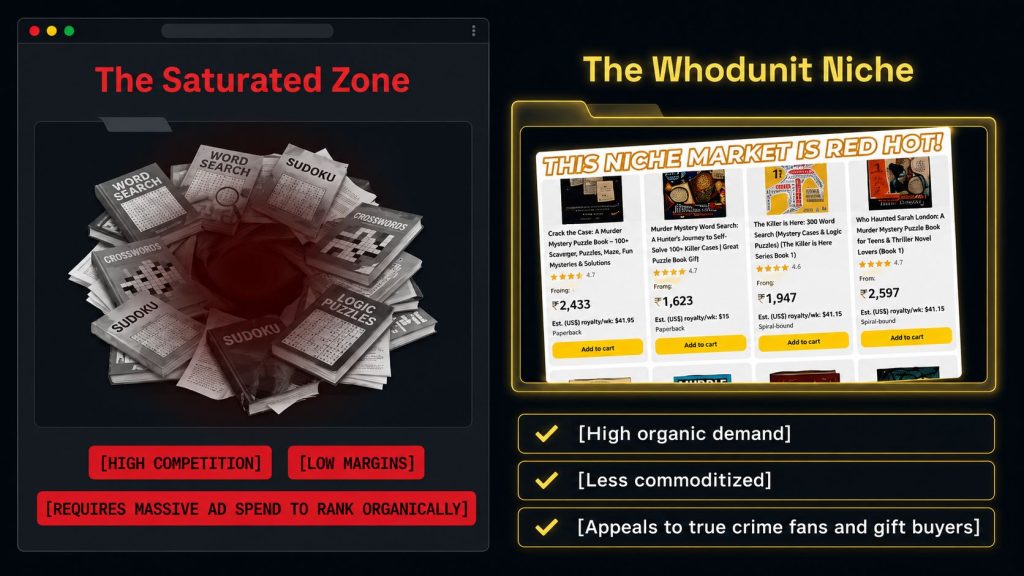
It’s worth understanding why “whodunit” logic puzzles are being positioned as a differentiated niche rather than just another puzzle type. Standard puzzle categories on Amazon KDP — word search, sudoku, coloring, mazes — have been mass-produced by low-content publishers for years, largely because they’re the easiest to generate with basic tools. That volume has pushed competition and advertising costs up while making it harder for a new title to rank organically without a real marketing push behind it.
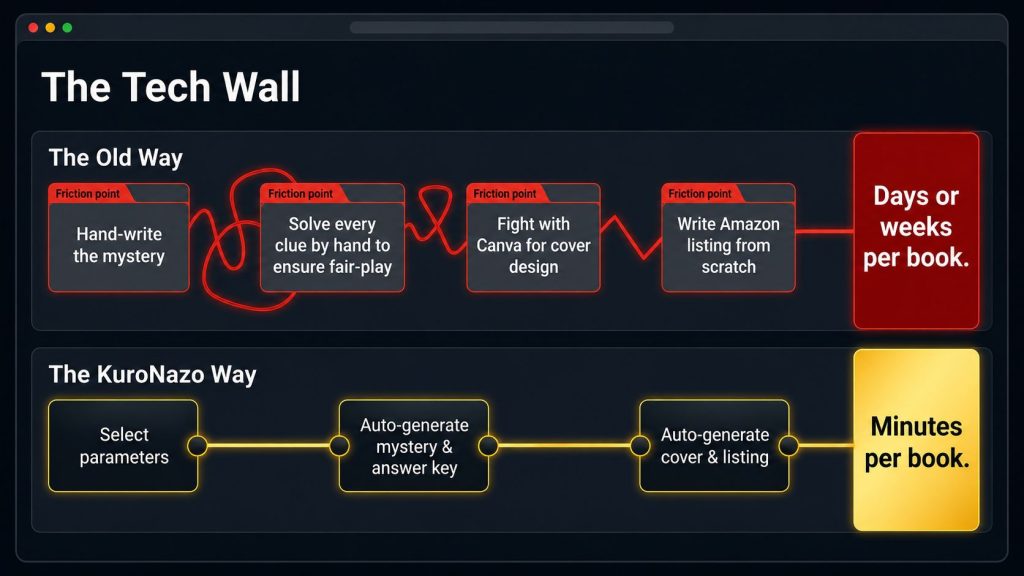
As explored in this KuroNazo Review, mystery and logic-deduction puzzle books occupy a smaller and less saturated niche within the broader puzzle book market. Unlike traditional crosswords or word searches, these puzzles challenge readers to track multiple variables—such as suspects, locations, motives, and timelines—to solve each case. That added complexity can make them more engaging for puzzle enthusiasts, but it has also made them significantly harder to produce at scale without manually creating every puzzle or relying on specialized software like KuroNazo.
That production difficulty is exactly what’s kept the category thinner than the oversaturated ones, and it’s the gap KuroNazo is built to close. None of that guarantees sales on its own — a differentiated niche still needs decent cover design, accurate keyword targeting, and a reasonable pricing strategy to convert browsers into buyers. But starting in a less-crowded lane is a real structural advantage over launching another word search title into a category that’s already full of them.
Is KuroNazo a Good Fit for Your Catalog?
Whodunit logic puzzles sit closer to brain-teaser and mystery-adjacent readers than to the crossword-and-sudoku crowd, and further still from children’s activity books. If you’re already publishing in puzzle or activity book categories and looking for a format that hasn’t been flooded the way word search and coloring books have, this is a reasonable direction to test. The “solve the case” framing tends to appeal more to adult and teen readers specifically, which matters if your existing catalog or audience skews toward that age range rather than early-childhood activity content.
If your catalog is built entirely around children’s coloring or tracing books, a whodunit logic puzzle line is a genuine pivot, not a natural extension — still worth testing as a way to diversify into an adjacent reader base, but don’t expect your existing audience to transfer over automatically. And if you’re brand new to KDP publishing altogether, the software solves the puzzle-generation part of the workflow, but not keyword research, cover competitiveness, or listing optimization — those skills still need to be built separately, regardless of which puzzle-generation tool sits underneath them.
Our Vetting Methodology — What We Actually Checked
Since this review was written the same day KuroNazo launched, it’s worth being explicit about the checklist behind it. We start with the creator, not the sales page — is there a verifiable history predating this launch, and does it hold up outside the platform’s own ecosystem? Ike Paz clears that bar with a long, checkable back catalog and a documented multi-year presence on WarriorPlus, though the specific 4.3/5 figure attached to Royalty Prints turned out to be an on-platform student rating rather than outside-verified, which this review corrects rather than repeats.
We also cross-reference funnel claims against sources beyond the vendor’s own JV page wherever possible. Here, that turned up a real contradiction between two outside descriptions of the funnel size rather than a clean match — worth reporting honestly rather than picking the version that reads better. We read the refund policy in the vendor’s own words rather than trusting a generic badge, and we separate on-page testimonials from independently verifiable claims rather than treating a screenshot as outside proof.
What none of this tells us: whether KuroNazo’s actual puzzle output is well-formatted, whether the KDP export meets Amazon’s current specifications without manual fixes, or whether the interface is genuinely beginner-friendly. Those are things only hands-on use can answer, which is exactly why this review keeps saying plainly that we haven’t used it yet, rather than implying otherwise.