
If you’ve been searching for a True Crime Vault Review to determine whether this AI-powered writing toolkit is worth buying, you’re in the right place. True Crime Vault is designed to help authors, self-publishers, and AI content creators generate fictional “true crime adjacent” stories using structured prompts rather than relying on real criminal cases. It combines hundreds of story premises, a chapter-consistency prompt, and bonus tools intended to speed up the creation of mystery and investigative fiction for platforms such as Amazon KDP.
True Crime Vault Review —
500 AI Novel Prompts, Full Funnel Checked
A $17 system built to stop AI-written novels from losing the plot by Chapter 8 — 500 story premises plus a master prompt for 20-chapter continuity. Here’s the complete funnel from a live WarriorPlus dashboard, a missing refund policy, and two things the JV page doesn’t tell affiliates.
⚠ Editorial First-Look Assessment — Not a Verified-Buyer Star Rating

Quick Verdict
True Crime Vault is a $17 AI fiction-writing system — 500 engineered “true crime adjacent” story premises plus a master prompt designed to keep a 20-chapter AI-written novel consistent from start to finish. Creator Alessandro Zamboni has one of the strongest, most independently documented track records this site has covered — Top 5% vendor and Top 1% affiliate on WarriorPlus, 18 years in the business. But two things need saying plainly: the JV page leaves OTO4 and OTO5 completely undescribed, with OTO5’s price actually mismatched against the live dashboard, and no refund policy is stated anywhere on either page. Full breakdown below.
Table of Contents
Quick Summary: What Is True Crime Vault?
True Crime Vault is a $17 system built for self-publishers who want to write full-length fiction with AI in the “true crime adjacent” style—the calm, forensic, documentary voice of true-crime storytelling applied to entirely fictional cases rather than real people or events. As you’ll see throughout this True Crime Vault Review, the package centers on two core assets: 500 fully engineered “Case Briefs” (story premises spanning 20 categories, from small-town disappearances and corporate cover-ups to cult investigations) and the Master True Crime Vault prompt.
Another feature highlighted in this True Crime Vault Review is the included bonus Cover Generator, which helps users create genre-appropriate book covers without requiring graphic design skills. This True Crime Vault Review evaluates four key areas: whether the “true crime adjacent” concept and chapter-consistency system provide meaningful advantages over standard AI prompts, how the complete sales funnel compares between the live WarriorPlus dashboard and the JV page, what could and couldn’t be verified regarding the refund policy, and what is publicly confirmed about the creator behind the launch.
Is AI Fiction Writing Actually a Viable Publishing Niche?
One of the strongest points highlighted in this True Crime Vault Review is that the core problem the product aims to solve—AI-generated long-form fiction losing narrative coherence over many chapters—is a genuine, well-documented limitation of today’s AI writing tools rather than a marketing exaggeration. Continuity drift, including forgotten character names, inconsistent timelines, and abandoned plot threads, is one of the most common frustrations reported by authors experimenting with AI-assisted novel writing. As this True Crime Vault Review found, these are exactly the kinds of structural issues a carefully engineered master prompt can meaningfully reduce, even though human editing remains an important final step.
Another finding from this True Crime Vault Review is that this limitation isn’t unique to any single AI model or provider. It’s a widely recognized characteristic of modern large language models, which have practical limits when maintaining context over extended writing sessions. Because of that, a system designed to force periodic re-reading of previous chapters and explicitly track important facts represents a technically sensible workflow rather than a gimmick wrapped in persuasive marketing. While it won’t guarantee perfect continuity, it addresses a real weakness in AI-assisted fiction writing with a logical solution.
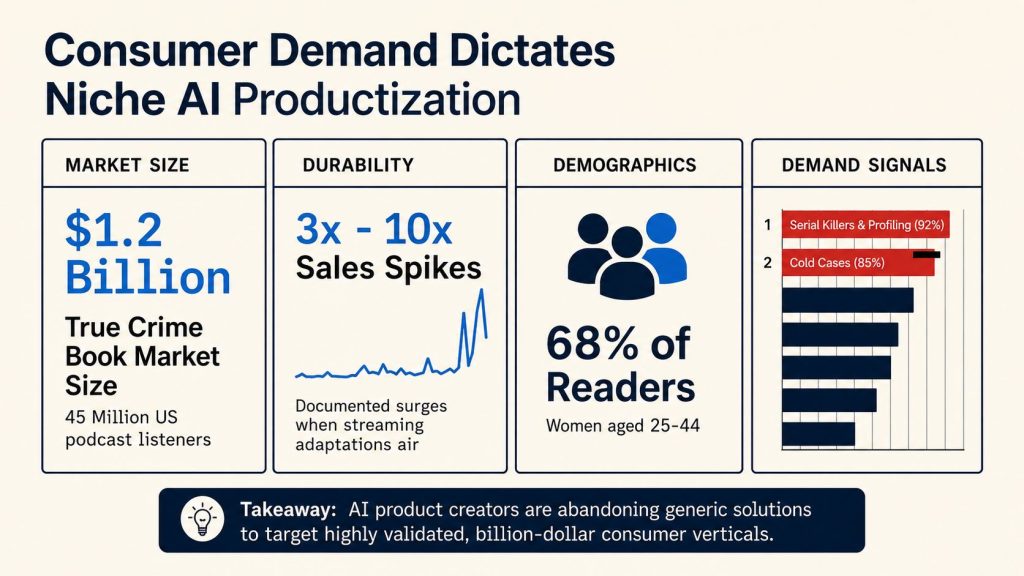
This True Crime Vault Review also gives credit to the product’s “true crime adjacent” positioning. Instead of encouraging users to write about real criminal cases, the system focuses on entirely fictional investigations presented in the familiar investigative and documentary style that readers already enjoy. That approach avoids many of the legal, ethical, and privacy concerns associated with using real people or real crimes while still capturing the storytelling appeal that has made true-crime books, podcasts, and documentaries consistently popular. From both a publishing and risk-management perspective, it’s a well-considered niche rather than simply a catchy marketing phrase.
Finally, this True Crime Vault Review examined the product’s claim that its content has long-term publishing value. Unlike prompt packs tied to a specific AI platform, software feature, or social media trend, fictional investigative stories aren’t dependent on changing technology or current events. The documentary storytelling style has remained popular for decades across books, television, and podcasts, making the niche relatively evergreen. That gives True Crime Vault a more durable foundation than many AI-related products whose usefulness can decline as platforms, algorithms, or AI capabilities evolve.
What’s Actually Inside the Vault
| Component | What It Does |
|---|---|
| 500 Case Briefs | Fully engineered story premises across 20 categories (25 briefs per category) |
| Master True Crime Vault Prompt | Forces one-chapter-at-a-time writing with continuity control |
| Re-Read Discipline | AI re-reads all established facts before writing each new chapter |
| Private Case File System | Tracks planted details and open threads across all 20 chapters |
| Structured Closing (Ch. 15+) | No new characters/subplots introduced; existing threads close deliberately |
| Real Endings (Ch. 20) | Designed to resolve every major question rather than trailing off |
| Cover Generator (Bonus) | Genre-specific cover templates with automatic title/author typography |
As this True Crime Vault Review found, the 20-category structure is more than a marketing bullet point—it provides meaningful organization rather than generic filler. The library covers niches such as small-town disappearances, wrongful convictions, cult investigations, corporate cover-ups, financial fraud, cold cases, and 14 additional categories, with 25 story briefs in each. This structured approach makes the collection genuinely easy to navigate instead of presenting users with a single, overwhelming list of 500 similar ideas.
Another point highlighted in this True Crime Vault Review is that the category-based organization improves the product’s practical usability. Writers looking for a specific type of fictional investigation—such as a cold case, financial fraud, or cult-related mystery—can jump directly to the relevant section without spending time filtering through hundreds of unrelated prompts. That level of organization adds real value for authors planning multiple books or building an ongoing publishing catalog. For the complete category list and sample story briefs, it’s worth reviewing the official sales page before making a purchase.
Master Prompt Systems vs. Writing Chapter-by-Chapter Yourself
It’s worthwhile to evaluate the core claim in light of how AI-assisted novel writing typically unfolds in the absence of a structured system. It’s technically feasible to manually re-explain a story’s established facts, characters, and unresolved plot points to an AI tool before each chapter, but in practice, most writers either skip this stepresulting in precisely the drift described on the sales pageor do it inconsistently throughout a long project, which yields a similar outcome, albeit more slowly. A pre-built master prompt that handles the re-reading and tracking step eliminates a particular, time-consuming source of error without substituting for real writing ability or editorial insight.
The honest acknowledgment of a practical constraint: no matter how well-designed a prompt system is, it can not eliminate the need for human editing. Even with flawless continuity tracking, AI-generated writing still requires a human editor to refine pacing, maintain consistent voice, and cultivate authentic narrative tension nuances a sophisticated prompt can assist with but can not entirely replicate. Buyers anticipating a completely hands-off publish-as-generated workflow should adjust their expectations; those seeking a genuinely helpful framework that eliminates the most tedious and error-prone aspects of long-form AI fiction writing are more likely to find that True Crime Vault fulfills its main promise.
The Complete 6-Product Funnel (Confirmed From the Live Dashboard)
| Product | Price | Affiliate Commission |
|---|---|---|
| Front End | $17.00 | $8.50 (50%) |
| OTO1 — 1,000 More Prompts | $27.00 | $13.50 (50%) |
| OTO2 — Custom GPT: Build Stories | $37.00 | $18.50 (50%) |
| OTO3 — Custom GPT: Promo Materials | $37.00 | $18.50 (50%) |
| OTO4 (unnamed on JV page) | $47.00 | $23.50 (50%) |
| OTO5 (unnamed, price mismatch) | $27.00 | $13.50 (50%) |
| Full Funnel Total | $192.00 | $96.00 |
None of the products in this funnel costs more than $200, so the “ separate purchase decision” framing used for this site doesn’t strictly apply here though the $ 192 total for the full funnel is still useful to know upfront compared to the $ 17 headline price. OTO2 and OTO3, especially the “ Custom GPT” builds, deserve close attention at checkout, as they suggest access to custom GPT features that might require a particular ChatGPT subscription level.
About the Creator: Alessandro Zamboni
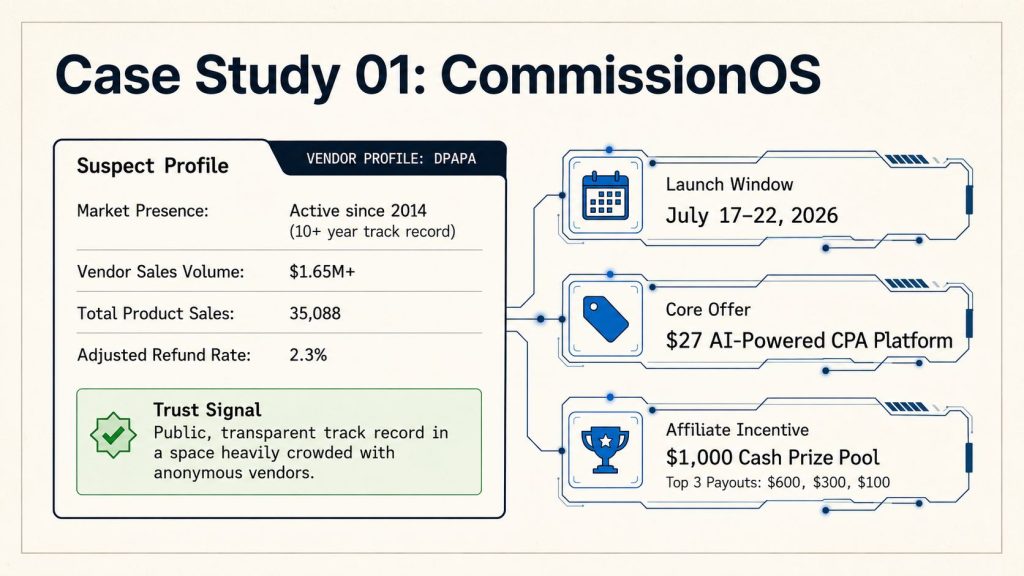
Alessandro Zamboni is an Italian online marketer and product creator who began his work in this field in 2008 one of the most thoroughly and independently documented creator profiles featured on this site. His WarriorPlus member profile and Amazon author biographysources external to his own sales copy for this particular launchboth independently state that he ranks among the Top 5% of vendors and Top 1% of affiliates on WarriorPlus, having received 18 quality-recognition awards from the platform across his catalog. An agreement between an author’s bio and their platform profile across sources provides a significantly more trustworthy signal than a single self-reported statement on a sales page.
Worth noting directly: this site has covered Alessandro Zamboni’s work before — an existing vendor archive page on ClickRetina references him directly, which gives this specific True Crime Vault review the benefit of an established prior relationship with this creator’s catalog rather than a first-time evaluation. That prior coverage is worth cross-linking internally for readers who want more context on his broader product history before deciding on this specific launch.
It’s important to be precise about what gives this level of corroboration a meaningfully stronger standing than most creator profiles featured on this site. Instead of relying on one isolated statement, three separate sources his WarriorPlus profile, an Amazon-hosted author bio, and this site’s previous coverage consistently corroborate the general outline of an 18-year, high-volume , platform-recognized career.
That type of multi-source agreementnone of which was requested or compensated for by this particular launchis significantly more difficult to fake than a single self-reported bio on one sales page, and it represents a real advantage that should be given substantial weight in favor of this creator, especially when compared to the two funnel-transparency issues and the missing refund policy also noted in this review. Few other launches featured on this site can be backed by as many independent, unrelated sources reaching the same general conclusion regarding a vendor’s reputation and durability in the market.
Pricing: Is $17 Worth It?
From a value perspective, this True Crime Vault Review finds the $17 front-end offer to be relatively low risk, particularly considering the amount of content included. With 500 story premises available, a publisher releasing just one novel per month would theoretically have more than 40 years of source material before exhausting the library. Because the prompts focus on fictional “true crime adjacent” stories rather than current events or rapidly changing technology, the ideas also have long-term reuse potential. As noted throughout this True Crime Vault Review, even a single successfully published 20-chapter novel on Amazon KDP could realistically recover the initial purchase price, while leaving hundreds of additional story concepts and the reusable master prompt available for future projects.
The more significant purchasing decision examined in this True Crime Vault Review involves the upsell funnel. OTO1, which expands the library with 1,000 additional prompts, is easy to understand, but OTO4 is listed only by price without a meaningful product description. Meanwhile, OTO2 and OTO3 are presented as Custom GPT products and are explained more clearly, although their usefulness depends on buyers having access to ChatGPT’s Custom GPT functionality. Combined with the absence of a clearly stated refund policy, this True Crime Vault Review recommends evaluating each upsell individually instead of purchasing the entire funnel by default.
Another conclusion from this True Crime Vault Review is that pairing the front-end product with OTO1 arguably represents the strongest value proposition in the entire funnel. At a combined cost of $44, buyers receive 1,500 story premises alongside the reusable Master True Crime Vault prompt. That combination significantly expands the available content while avoiding the uncertainty surrounding the less-documented OTO4 and OTO5 offers. For authors whose primary goal is to build a large backlog of publishing ideas, this pricing tier provides a logical stopping point without requiring an all-or-nothing investment.
Finally, this True Crime Vault Review places OTO2 and OTO3 into context for buyers unfamiliar with ChatGPT’s Custom GPT feature. Unlike simply copying and pasting prompts into a standard conversation, Custom GPTs allow users to save reusable instructions, behaviors, and knowledge into dedicated AI assistants that can be accessed repeatedly. That can make the writing workflow more convenient, but the value of these two upsells depends entirely on whether a buyer’s ChatGPT subscription supports creating and using Custom GPTs. Confirming that compatibility before purchasing either upgrade is a sensible precaution.
What Would Make This a Stronger Recommendation
Nothing raised in this True Crime Vault review is disqualifying at a $17 price point, particularly given how strong the creator’s independently verified track record is, but it’s worth being specific about what would move this from a solid, low-risk pick to a fully confident one. First and most directly, adding actual product descriptions for OTO4 and OTO5 on the JV page — matching the specificity already given to OTO1 through OTO3 — would close the single biggest transparency gap in this review. Second, correcting the OTO5 price discrepancy between the JV page and the live dashboard would remove a genuine, verifiable inconsistency.
Third, clearly outlining even a limited or technically specific refund policy would align this launch with the standard practices observed in most other offers the site has evaluated. None of these requests are out of line for a creator at this level of platform credibility, and their omission speaks more to the specific page setup for this launch than to any wider trend in Alessandro Zamboni’s broad catalog, which extends far beyond this one True Crime Vault release.
Who True Crime Vault Actually Makes Sense For
✅ Buy It If
- You’ve tried writing AI fiction before and specifically hit the continuity-drift problem this system is built to solve
- You want a large, reusable premise library rather than a handful of ideas you’ll burn through quickly
- You value buying from a creator with a long, independently verified WarriorPlus track record
- You’re comfortable purchasing without a stated refund guarantee, given the low $17 entry price
❌ Think Twice If
- You need a refund guarantee stated in writing before purchasing anything
- You’re not interested in fiction writing or self-publishing specifically
- You’d want a clear description of OTO4 and OTO5 before deciding, rather than buying on trust
- You don’t have ChatGPT access with custom GPT capability, which OTO2 and OTO3 appear to depend on
How to Actually Use True Crime Vault (3 Practical Setups)
1. One-book-a-month publishing cadence. Choose one Case Brief, run the Master True Crime Vault prompt across all 20 chapters over a focused week, edit and format for KDP, then publish repeating this monthly provides a self-publisher with a genuinely sustainable, evergreen approach to building a catalog, without needing to invent new premises from scratch each time.
2. Category-focused series building. With the 500 briefs divided into 20 categories of 25 each, a writer can focus on one categorysuch as cold cases reopened or cult investigationsand develop a themed series that maintains consistent reader expectations across every title, instead of switching between unrelated true-crime-related subgenres.

3. Testing the system before committing to volume. Without a refund policy in place, a prudent strategy is to focus only on the front end and one Case Brief to fully draft and assess a complete novel before determining whether any of the OTOs especially the less-detailed OTO4 and OTO5 are worthwhile to include.
4. Cross-genre voice reuse. Since the sales page notes the Master True Crime Vault prompt works with any story idea, not just the 500 included premises, writers can apply the same continuity-discipline system to their own original true-crime-adjacent concepts once they’ve internalized how the prompt structure works, extending the tool’s useful life well beyond the initial 500-premise library. This kind of long-term reusability is worth weighing into the price comparison covered earlier — the master prompt itself, independent of any specific premise, is arguably the more durable half of the purchase over a multi-year publishing timeline.